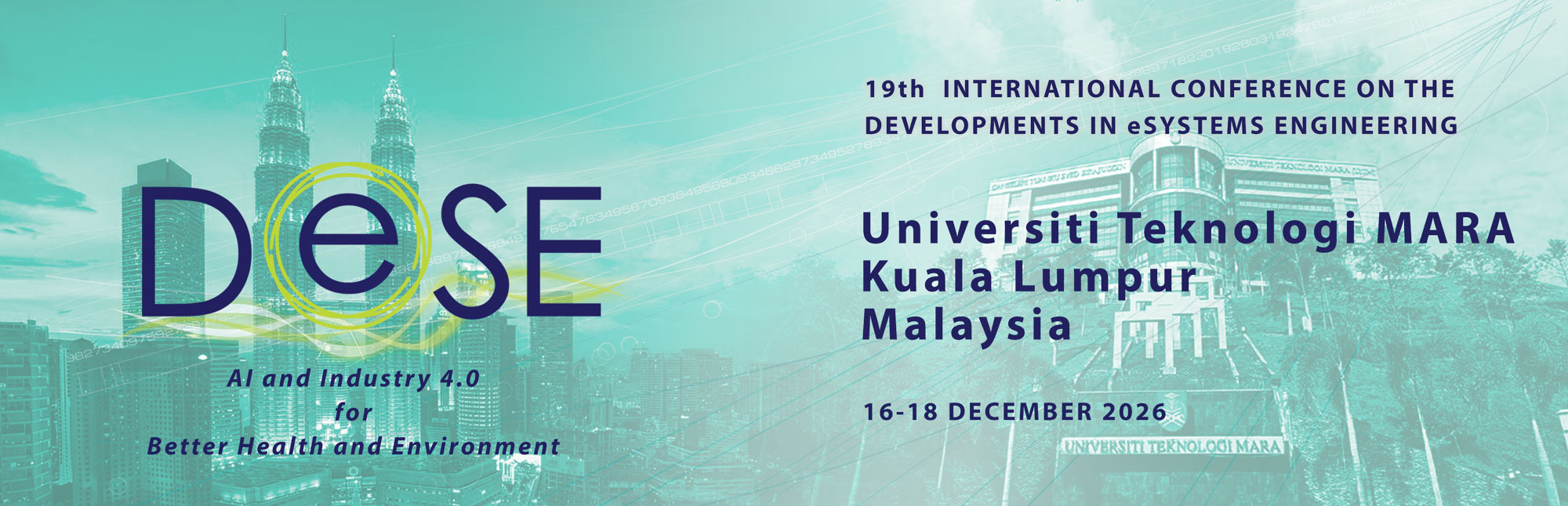
AI4HBD 2026: International Session on Artificial Intelligence for Healthcare, Bioinformatics, and Drug Discovery
This special session is organised and supported by the following educational partner
University of Sharjah

University of Fallujah

Session Chair:
- Dr Ayad Turky, University of Sharjah, UAE.
- Dr Omar Salah F. Shareef, University of Fallujah, Iraq.
Session Co-Chairs:
- Dr Nasser R Sabar, La Trobe University, Australia.
- Prof Andy Song, RMIT university, Australia.
- Dr Heba Mohammed Fadhil, University of Baghdad, Iraq.
- Dr Dheyaa A. Ibrahim, University of Fallujah, Iraq.
- Dr Ahmad A. AlSabhany, University of Fallujah, Iraq.
- Dr Ibrahim Abaker Hashem, University of Sharjah, Iraq.
- Dr Ahmed J. Aljaaf, University of Anbar, Iraq.
- Dr Mohammed Al-khafajiy, University of Lincoln, UK.
- Dr Salwani Abdullah, Universiti Kebangsaan Malaysia, Malaysia.
Synopsis:
The rapid development of Artificial Intelligence (AI) is transforming healthcare, biomedical research, and drug discovery. Recent advances in machine learning, deep learning, and data-driven approaches are enabling more accurate disease diagnosis, intelligent medical imaging analysis, biomedical signal processing, and AI-based drug discovery. At the same time, the increasing availability of medical data, genomic data, and biomedical datasets creates new opportunities for interdisciplinary research combining AI, bioinformatics, and healthcare applications.
This session aims to provide a focused forum within DESE 2026 for researchers, practitioners, and industry experts working at the intersection of Artificial Intelligence, healthcare, bioinformatics, and drug discovery. The session complements the main conference tracks in Artificial Intelligence, data science, computer vision, and knowledge engineering, and encourages interdisciplinary contributions that combine advanced AI techniques with real-world medical and biological data.
The session will particularly encourage submissions that focus on practical AI applications in healthcare systems, medical imaging, biomedical signal analysis (such as ECG and EEG), bioinformatics, and intelligent drug discovery. It will also promote collaboration between AI researchers, healthcare professionals, and biomedical scientists by providing a platform to present recent research results, discuss challenges, and explore future research directions.
Therefore, this special session invites authors to submit high-quality research papers on AIHBD, covering topics which include (but are not limited to) the following:
- Logistics 4.0
- Artificial Intelligence (AI) for healthcare systems
- AI for clinical decision support systems
- AI for disease diagnosis, prognosis, and prediction
- AI for precision medicine and personalized healthcare
- Explainable and trustworthy AI in healthcare
- AI for patient monitoring and early disease detection
- AI for smart hospitals and digital healthcare systems
- Deep learning for medical image analysis
- AI for radiology, MRI, CT, X-ray, and ultrasound imaging
- AI for ECG, EEG, and wearable healthcare devices
- Multimodal learning using medical images and clinical data
- Computer vision for disease detection and medical diagnosis
- Machine learning for gene expression analysis
- AI for genomics, proteomics, and transcriptomics
- AI for biomarker discovery and disease prediction
- Deep learning for biological sequence analysis
- Graph neural networks for biomedical data
- AI-based drug discovery and drug repurposing
- Machine learning for drug–target interaction prediction
- AI for drug synergy and combination therapy prediction
- Deep learning for molecular representation learning
- AI for toxicity prediction and drug response prediction
- Generative AI for healthcare and bioinformatics
- Large language models (LLMs) for medical applications
- AI for multimodal biomedical data integration
- Transfer learning in biomedical datasets
- Federated learning and privacy-preserving AI in healthcare
- Real-world AI deployment in healthcare environments
Paper Submission
Prospective authors are invited to submit full-length papers (not exceeding 6 pages) conform to the IEEE format . All papers will be handled and processed electronically via the EDAS online submission system